The Undercurrent Encyclopedia
The Two-Party Doom Loop
The Two-Party Doom Loop, (n.): A reinforcing feedback cycle in which partisan polarization raises political stakes, which intensifies partisanship, which raises stakes further. A trap distinguished from ordinary political conflict by the cheerful detail that no one installed an off switch.
Democracy depends on losers accepting their losses and winners giving losers a fair shot next time. The “two-party doom loop” describes what happens when this bargain collapses inside a system with only two choices. Two parties turn every contest into a binary: us or them, win or lose, all or nothing. No third team to absorb dissent, broker compromise, or offer an off-ramp. So each side’s hardball convinces the other side the process is rigged, which justifies further hardball, which further erodes the shared sense of fairness. A reinforcing feedback loop, like a microphone aimed at its own amplifier.1 The two-party structure isn’t the context for the doom loop. It’s the amplifier.
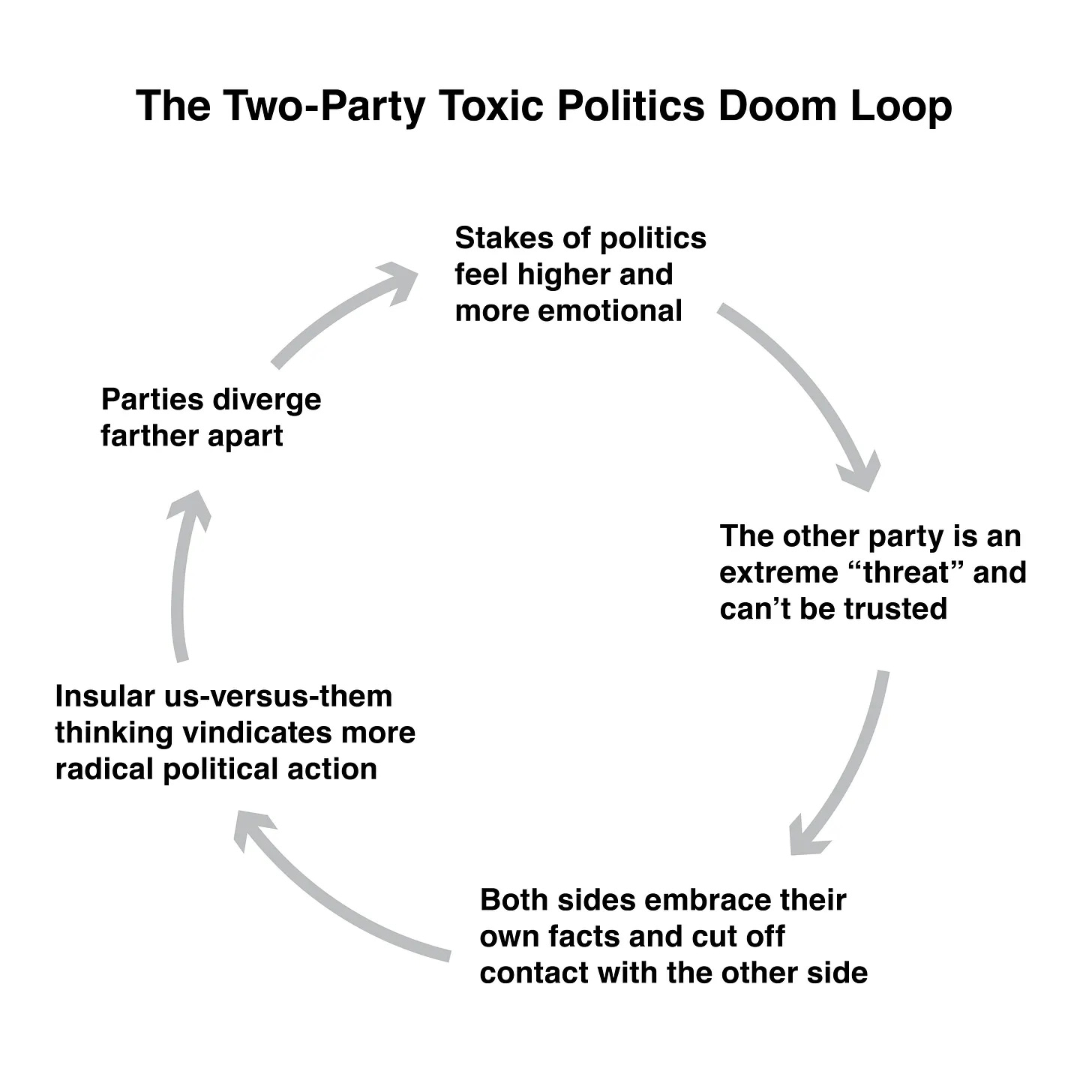 From Breaking the Two-Party Doom Loop (Oxford University Press, 2020).
Sorting into teams. Until the 1960s, both parties contained liberal and conservative factions, a hidden “four-party system” that forced internal negotiation. Civil rights, culture wars, and residential migration dissolved that overlap.2 Once a party gives up competing in a region, it stops recruiting candidates and investing resources there, which makes it weaker there, which makes it give up more. The parties don’t just disagree. They’ve stopped showing up.
Binary logic. Two teams, high stakes, disloyalty is dangerous. Anything that criticizes your team helps the opposing team. And you must always remember: the opposing team is bad. Very bad! Critical lips sink ships. When Republicans uncomfortable with Trump wanted somewhere else to go, there was nowhere. Almost all of Trump’s GOP critics have vanished or succumbed to MAGA-fication.3 You can hate how the game works and still play it. What else are you going to do? Vote for the other team?
The subversion dilemma. Citizens convinced their opponents threaten democracy grow willing to break democratic norms to stop them from governing. Democracy hypocrisy: we participate in democracy’s breakdown even as we think we’re preserving it. In 2023, about 80 percent of Republicans said Democrats didn’t respect democratic institutions. About 75 percent of Democrats felt the same about Republicans.4 Both sides convinced the other is the authoritarian one. Both partly right.
And then the loop produces its cruelest product. Not hatred of the other side. Disillusionment with the entire system. Pew tracked Americans who view both parties unfavorably: 6 percent in 1994, 28 percent by 2023. By 2025, 38 percent felt neither party fights for people like them.5 When most citizens feel alienated from both options, the legitimacy crisis isn’t partisan. It’s structural.
Every doom loop looks, from the inside, like a series of reasonable responses to the other side’s provocations. That’s what makes it a loop.
-
Lee Drutman, Breaking the Two-Party Doom Loop: The Case for Multiparty Democracy in America (New York: Oxford University Press, 2020), 26-30. ↩︎
-
Drutman, Breaking the Two-Party Doom Loop, 85-103. ↩︎
-
Lee Drutman, “Doomier and Loopier: Why Our Two-Party System Will Not and Cannot Self-Correct on Its Own,” Undercurrent Events, May 15, 2025. ↩︎
-
Drutman, “Doomier and Loopier.” ↩︎
-
Drutman, “Doomier and Loopier,” citing Pew Research Center and NBC News polling. ↩︎
Further Reading
Lee Drutman, Breaking the Two-Party Doom Loop: The Case for Multiparty Democracy in America, paperback edition with new preface (New York: Oxford University Press, 2022).
Lee Drutman, “Doomier and Loopier: Why Our Two-Party System Will Not and Cannot Self-Correct on Its Own,” Undercurrent Events, May 15, 2025.
Lee Drutman, “We Are Still Living in the Doom Loop,” Undercurrent Events, September 13, 2025.